Masterpieces of the Musée Jacquemart-André
The Painting Room and the Grand Salon
We begin with the reception rooms. The Painting Room sets the tone for Édouard André’s collection: 18th-century French art, with Chardin, Boucher, and Fragonard hung in the very room for which they were acquired. The Boucher to remember is Venus Adorning Herself with Juno’s Attributes, a canvas that engages in dialogue with the woodwork rather than competing with it. The Grand Salon follows: this is the room everyone photographs, the one Saturday afternoon visitors drift through slowly, and the only one you can see empty if you come in the evening.
The Tapestry Room and the Music Room
The tapestries depicting the story of Achilles fill their entire room. They are meant to be viewed as a sequence: you walk around the space, following the narrative from panel to panel, which takes a good five minutes—though almost no one takes the time. The Music Room, on the other hand, is where you grasp the house’s original purpose: to entertain, to listen, to display. It’s also one of the rooms featured in the opera evenings, restoring its original function for two hours.
The Smoking Room and the Canalettos
In the smoking room, an informal space adjoining the vestibule, hang two Canalettos: St. Mark’s Square and The Rialto Bridge. Venice thus arrives on the ground floor, even before the upper level, setting the stage for the Tiepolo ceiling that follows immediately.
Rembrandt and Northern European Painting
The house’s Rembrandt is The Pilgrims of Emmaus. It’s the painting I linger before the longest, and I recommend seeing it early, when the room is still quiet. Van Dyck and Reynolds complete this vein: portraiture from the North and England, facing off against 18th-century French works. Two tastes in the same room—precisely the essence of this house.
The Winter Garden and the Staircase
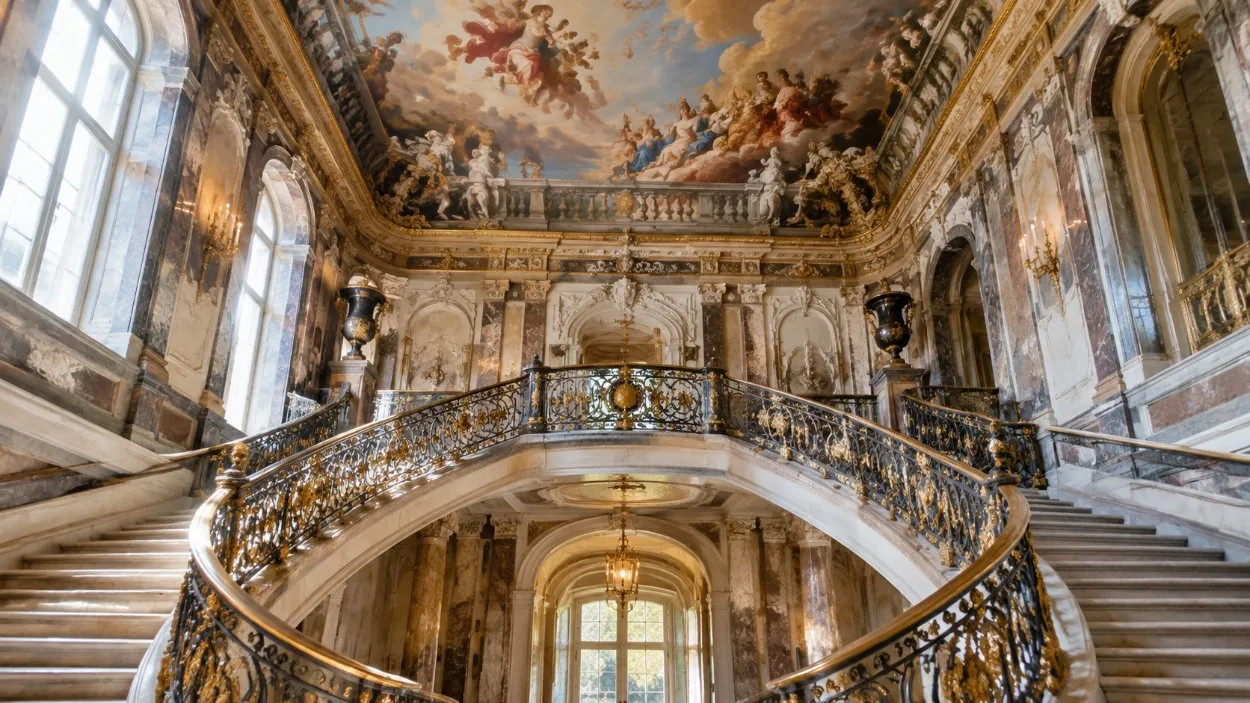
Next comes the winter garden: marbles, palm trees, mirrors—a room designed for impact, and it still delivers. It opens onto the double-revolution staircase, Henri Parent’s masterstroke that made the mansion famous upon its inauguration in 1876. Above it runs Tiepolo’s fresco, Allegory of Justice and Peace, painted in Venice in the 18th century and restored between autumn 2023 and September 2024. The staircase is climbed twice: once up each flight, to view the fresco from two angles. The building’s history is detailed in the history of the Hôtel André.
The Private Apartments and the Botticelli
The study, the boudoir, the library, Madame’s bedroom, and Monsieur’s bedroom form a narrower enfilade, where visitors move slowly because the rooms are small. Botticelli’s Madonna and Child is best admired up close. These rooms tell the story of the couple as much as the collection: I discuss it further on the page about Nélie Jacquemart.
The Italian Museum, on the Upper Floor
Upstairs, the century and country change. The Sculpture Room brings together Renaissance sculpture, while the Florentine and Venetian rooms showcase painting. Uccello’s Saint George Slaying the Dragon is displayed here—a small panel whose perspective alone makes the climb worthwhile. Mantegna and Giovanni Bellini complete the collection. This is Nélie Jacquemart’s contribution, and the reason the museum regularly hosts Italian exhibitions, including Eternal Tintoretto this season.
What works
- Rembrandt’s The Pilgrims of Emmaus, in a human-scale room
- Two Canalettos in the smoking room, even before Venice upstairs
- The restored Tiepolo fresco, seen from the double-revolution staircase
- Uccello, Mantegna, and Bellini united on the first floor
Things to know
- The private apartments are narrow: best avoided on Saturday afternoons
- Flash photography is prohibited in all rooms
- The temporary exhibition requires the exhibition ticket and a time slot
- Buy your ticket at the museum, not on GetYourGuide
Head upstairs first if you arrive at opening time. The Italian museum is the part everyone saves for last, and at 10 a.m. you’ll have Uccello all to yourself. The ground floor holds up just fine later.
How long does it take to see everything?
An hour and a half to two hours is enough for the mansion and its collections, plus forty-five minutes to an hour more with the exhibition. Room-by-room details are on the visit duration page, and the recommended route is on what to see. The dining room, meanwhile, has become the tea room, under a second Tiepolo ceiling, with no ticket or reservation required.
See the salons in a different light
After closing time, opera takes place in these same rooms, with a glass of champagne and a private tour of the ground-floor collections. Dates are listed below.
Reminder: the above evening event is booked via GetYourGuide, but the museum entry ticket is purchased at the museum ticket office or at the desk at 158.
Frequently asked questions
What is the most famous painting in the Musée Jacquemart-André?
Rembrandt’s The Pilgrims of Emmaus, on the ground floor, along with Botticelli’s Madonna and Child and Uccello’s Saint George. The full tour is on what to see.
Where are the Canalettos?
In the smoking room: Saint Mark’s Square and The Rialto Bridge. They are preparing the Tiepolo ceiling for the staircase. See the history of the mansion.
What is the Italian museum?
The first floor: Sculpture Room, Florentine Room, Venetian Room, featuring Uccello, Mantegna, Giovanni Bellini, and Renaissance sculpture. Allow thirty minutes, depending on the length of your visit.
Can you see the masterpieces in the evening?
Yes, on Fridays until 10 PM, or during the evening salons, which include a private tour of the ground floor. See opening hours.