The complete guide to the Jacquemart-André Museum
I ran an art bookshop on Rue de Miromesnil for twenty years and live on Rue de Courcelles, a five-minute walk from 158. I know the house through its caretakers and the regulars at the tea room, and for years I’ve seen the same scene: a visitor arrives on a Saturday at 3 PM, climbs the grand staircase in single file, and leaves thinking the museum is small. It isn’t. It was just crowded.
What this house is
An hôtel particulier built from 1869 to 1875 by architect Henri Parent for Édouard André, a banker and former officer of the Imperial Guard, on a plot of the then-new Boulevard Haussmann. The façade is set back from the street alignment, which is noticeable from the opposite sidewalk. In 1881, Édouard married Nélie Jacquemart, a portraitist who had painted his portrait nine years earlier; together, they purchased works—primarily in Italy—over thirteen years. After his death, she continued collecting alone and bequeathed everything to the Institut de France in 1912 with precise hanging instructions. The museum opened on December 8, 1913. What you visit is therefore a lived-in house, with its reception rooms, private apartments, and, upstairs, the “Italian museum” built for Uccello, Mantegna, and Bellini. The chronology is available on the history page of the Hôtel André.
Where to buy the ticket
At the museum. I mention this first because it’s the question I’m asked most often: the standard admission ticket is not available for reservation on GetYourGuide, nor does that site sell it. It can be purchased on the museum’s online ticket office or at the counter, with no obligation to book in advance. During an exhibition, two types of tickets are available. The “collections only” ticket grants access to the mansion and its permanent collections, with no time restrictions. The “collections + exhibition” ticket is more expensive and requires selecting a 15-minute entry slot for the exhibition; afterward, the visit is unrestricted. Tickets purchased online skip the counter queue and can be presented on screen or printed. Free admissions and reduced rates are listed on the ticket prices page, without specific amounts, as the museum updates them regularly.
The three decisions
The first: whether to see the exhibition. “Eternal Tintoretto” occupies the temporary exhibition rooms from September 11, 2026, to January 24, 2027, featuring around forty paintings and drawings from Venice, Vicenza, Turin, Vienna, Florence, and the Louvre. If Tintoretto speaks to you, opt for the exhibition ticket and choose an early time slot. Otherwise, the “collections only” ticket is sufficient and lets you enjoy the house at your own pace.
The second: the time. The museum is open every day, including Mondays and Tuesdays—a rarity in Paris—and on Fridays until 10 p.m. The two quietest times are at opening (10 a.m. on weekdays) and after 6 p.m. on Fridays. On Saturdays between 2 p.m. and 5 p.m., the brunch and tea time crowds from the tea salon add to the exhibition rush, and the double-revolution staircase becomes a queue. Daily details are available on the opening hours page.
The third: the tea salon. Le Nélie occupies the André family’s former dining room, beneath Tiepolo’s painted ceiling, with a terrace overlooking the courtyard. It can be visited without a ticket or reservation—the restaurant doesn’t take bookings. You can enter for a coffee at 9:30 a.m. on weekdays, admire the ceiling, and then decide whether to purchase a ticket.
The route and the time
Allow 1.5 to 2 hours for the mansion and its collections, plus 45 minutes to an hour for the exhibition. On the ground floor, the reception rooms follow one another: the Painting Room, the Grand Salon, the Tapestry Room with the story of Achilles, the Music Room, then the Winter Garden with its marbles, palm trees and mirrors, from which the double-revolution staircase rises beneath Tiepolo’s fresco. The private apartments—study, boudoir, library and two bedrooms—take about fifteen minutes. Upstairs, the Italian museum requires half an hour if you pause before Uccello’s Saint George. A room-by-room timing guide is available on the visit duration page.
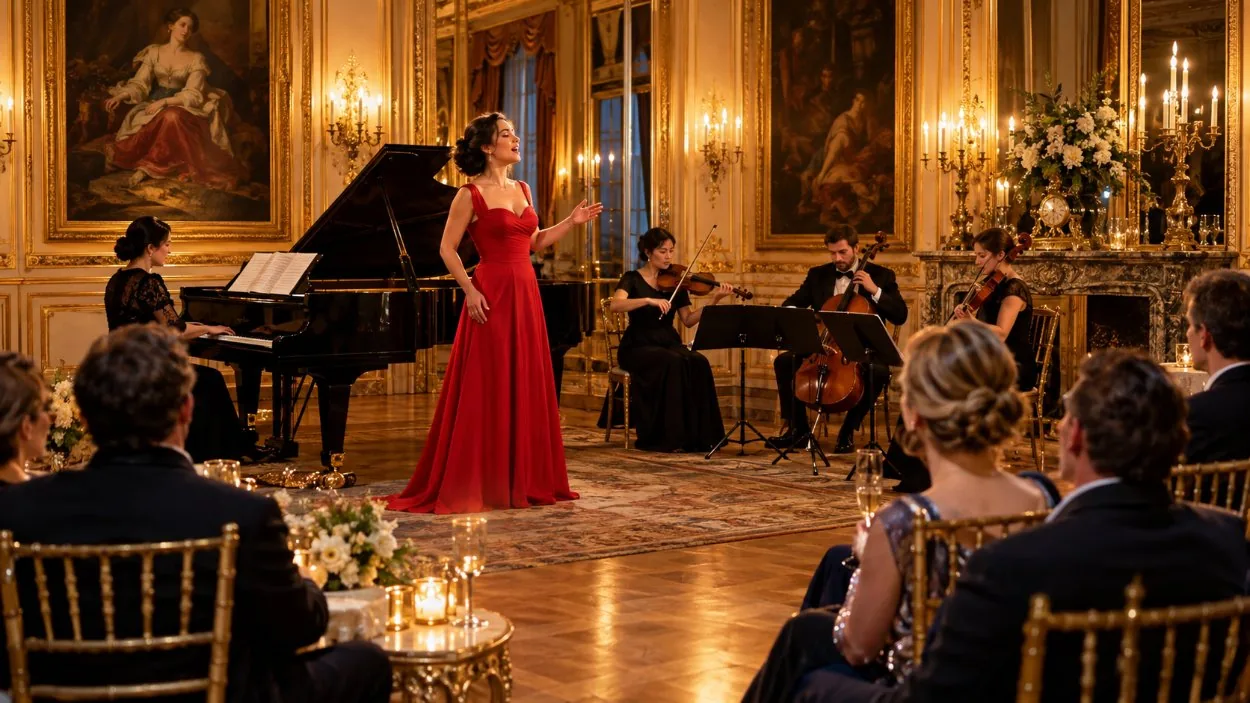
The salons at night
This is where GetYourGuide comes in handy. After closing time, two Verdi operas are performed in the ground-floor salons, in Italian, in a shortened adaptation with a small number of singers and musicians. La Traviata, from September 19 to December 19, 2026: doors at 8:00 PM, start at 8:30 PM, ending around 10:45 PM, three roles, a trio of musicians, a glass of champagne and a private tour of the ground-floor collections. Rigoletto, from October 10 to December 12, 2026, 80 seats, five roles, piano, violin and cello, with the story moving from salon to salon. Elegant attire is required in both cases, with open seating for La Traviata. One visitor noted the lack of air conditioning during the July heatwave and tightly packed chairs. This is the only way I know to see the Grand Salon without anyone in front of you. The full schedule is available on the opera in the salons page.
What I would book
For the daytime visit, nothing here: just a collections-only ticket from the museum’s ticket office, on a Friday around 6:00 PM, and tea at the salon before or after. To see the salons differently, the Traviata evening, rated 4.8 out of ten reviews, which remains a luxury experience, priced like a gourmet dinner for two. To understand the boulevard on which Édouard André built his mansion, the private 2-hour walk, which starts at the Opéra, passes by No. 158 without entering, and ends at Parc Monceau. For the same day, the Palais Garnier is a fifteen-minute walk away, with short opening hours to check before leaving. Save the nighttime cruise for another evening: the opera ends too late to catch it.
Book an evening in the salons
La Traviata and Rigoletto dates, slot by slot. Details of both performances are on the opera evenings page.
Reminder: the above evening event is booked via GetYourGuide, but the museum entry ticket is purchased at the museum ticket office or at the desk at 158.
Frequently asked questions
Does the guide replace the audio guide?
No. This page prepares your visit; the museum’s app provides room-by-room commentary. The four tours are described on the audio guide page.
How much time should you allow in total?
One and a half to two hours for the house, another forty-five minutes to an hour with the exhibition, plus the tea room. Timing details are on the visit duration page.
What should I start with if I only have half a day?
The reception rooms, the staircase, and the winter garden, then the Italian museum upstairs. The full itinerary is on the what to see page.